The first time my old pickup started shimmying at 65, I was sure the whole front end was shot. Every time I touched the brakes coming down an interstate off-ramp, the steering wheel danced in my hands like it was trying to get away from me. I’d priced out ball joints in my head before I even pulled into the driveway.
It turned out to be the front rotors, and not for the reason the guy at the parts counter told me. If your car shakes when you brake from highway speed but drives smoothly otherwise, this is the order I check things in now: cheapest and most likely first, expensive and rare last.
Shop notes
- Shakes only when braking: rotors are the usual suspect, calipers second.
- Shakes at speed whether you brake or not: start with tires and wheel balance, not brakes.
- Steering wheel shakes: usually the front brakes. Pedal or seat pulses: can be front or rear.
- Car pulls to one side or smells hot: suspect a sticking caliper and don’t put it off.
Step 1: Pin down exactly when it shakes
Before you touch a wrench, take a short, safe drive on a road you know and pay attention to three things. They narrow the problem down more than any part you could buy.
- Braking vs. cruising. If the vibration is there at a steady 60 to 70 mph with your foot off the brake, it’s probably not a brake problem. Tire balance, a bent wheel or a tire with a broken belt are far more likely. A shake that only shows up when you press the pedal points to the brakes.
- Where you feel it. A shake through the steering wheel usually comes from the front axle. A pulsing pedal or a vibration through the seat and floor can come from either end, and rear rotors or drums are common culprits.
- Speed and pressure. Many rotor problems are worst during long, gentle stops from highway speed and feel smoother during hard stops or around town. Note when it’s strongest.
Write it down. “Steering wheel shakes, gentle braking from 65, gone below 30” is a description any mechanic will thank you for, and it will keep you from replacing the wrong parts.
Step 2: Check the lug nuts
This one sounds too simple, but I’ve seen it cause brake shudder more than once. Lug nuts tightened unevenly, or hammered on with an impact gun, can distort the rotor hat as it clamps against the hub. Over a few thousand miles that turns into a shake.
If the wheels were off recently for tires, a rotation or a brake job, check the lug nuts with a torque wrench in a star pattern to your vehicle’s specification. The spec is in your owner’s manual. If several nuts were well over or under spec, there’s a good chance you just found the cause of future rotor problems, even if the rotors themselves now need attention.
Step 3: Look at the rotors
Most people call it “warped rotors.” In reality, the rotor usually isn’t bent like a potato chip. More often it has thickness variation: some spots on the braking surface are slightly thicker than others. Each time a thick spot passes through the pads, the caliper pushes back a tiny bit, and you feel that as a pulse in the pedal or a shake in the wheel. A difference of a few thousandths of an inch is enough.
Thickness variation usually comes from one of these:
- Uneven pad deposits. Holding the brakes hard at a stop after a long, hot stop can leave a pad-shaped patch of friction material on the rotor.
- Runout. A rotor that wobbles slightly as it turns, often from rust or debris between the rotor and hub, or uneven lug torque, gets worn unevenly over time.
- Heat spots. Repeated hard braking, towing or mountain driving can create hard, bluish spots on the surface.
- Pads that were never bedded in. New pads need a break-in procedure to lay down an even layer of material.
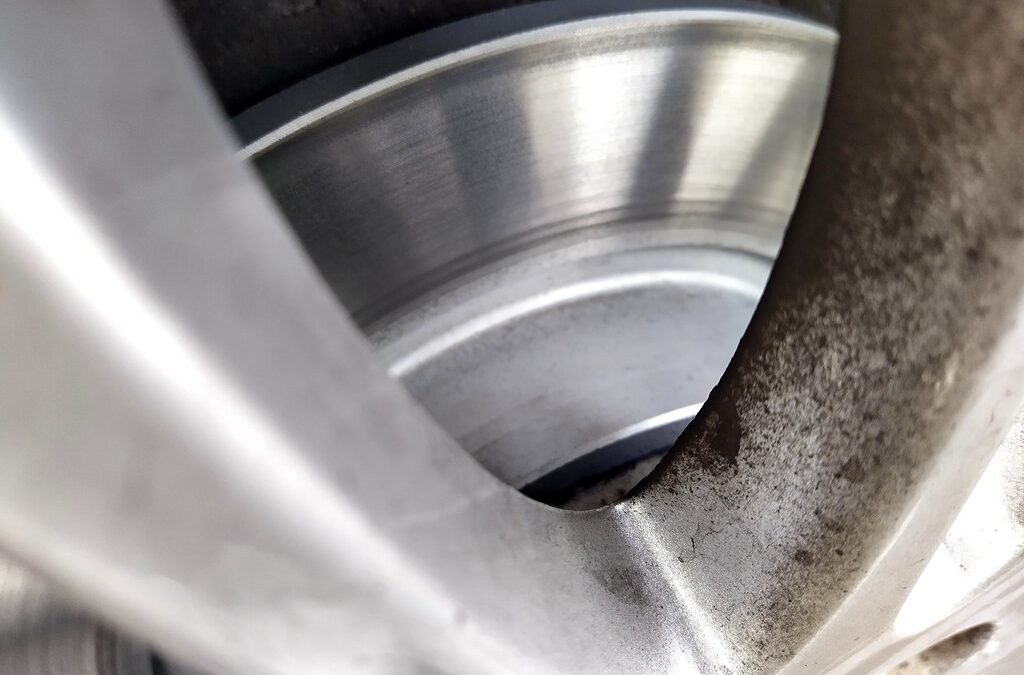
With the wheel off and the car safely supported on jack stands, look at the rotor surface. Blue or dark patches, a pad-shaped imprint, deep grooves or a heavy lip at the outer edge are all clues. You can’t measure thickness variation by eye; a shop uses a micrometer and a dial indicator for that. But if your symptoms match and the rotors look rough or are near the minimum thickness stamped on the rotor, replacement is usually the practical fix.
Resurface or replace?
Rotors can sometimes be machined smooth if they’re thick enough to stay above the minimum thickness afterward. On many modern cars, rotors are thin to begin with and affordable to replace, so new rotors are often the better value. Either way, always replace or resurface rotors in pairs on the same axle, and use new pads.
Step 4: Rule out a sticking caliper
A caliper that doesn’t release fully keeps the pads dragging on the rotor. That overheats the rotor and can create exactly the kind of uneven surface that causes shudder. Signs to look for:
- The car pulls to one side when you brake, or even when you don’t.
- A hot or burning smell after a drive.
- One wheel is noticeably hotter than the others after a short drive. Hover your hand near each wheel. Don’t touch the rotor; it can burn you.
- Uneven pad wear: one pad much thinner than the other on the same wheel.
Often the problem is the caliper slide pins rather than the piston. Pins that are dry, rusted or bent stop the caliper from floating freely. Cleaning and re-greasing them with a high-temperature brake lubricant is a common fix during a pad and rotor job. A piston that’s seized or a leaking caliper needs replacement.
Step 5: Look at suspension and steering parts
Worn suspension parts don’t usually cause brake shudder by themselves, but they make a small rotor problem feel much worse. When you brake, the weight shifts forward and a loose part lets the whole assembly move.
Common offenders are worn lower control arm bushings, loose tie rod ends and worn ball joints. If the shake feels violent for what should be minor rotor wear, or if you hear clunks over bumps, have the front end inspected. A quick check you can do at home: with the front wheel off the ground, grab the tire at 3 and 9 o’clock and rock it, then at 12 and 6. Noticeable play is a sign something needs a closer look.
Step 6: Don’t skip tires and wheels
If your shake shows up at highway speed even without braking, go back to the tires before spending money on brakes. A thrown balance weight, a tire with a separated belt or a bent wheel from a pothole can all cause vibration that feels worse when you brake. A tire shop can balance the wheels and spot a damaged tire quickly and cheaply.
Tow or go?
| What you notice | Likely cause | Verdict |
|---|---|---|
| Mild shake only when braking from speed | Rotor thickness variation | Drive gently, book the repair |
| Shake at steady highway speed, braking or not | Tire balance, damaged tire or bent wheel | Get tires checked soon |
| Pulls to one side, hot or burning smell | Sticking caliper or slide pins | Stop soon and inspect |
| Grinding metal, pedal goes soft or to the floor | Pads worn out or hydraulic problem | Do not drive. Tow it. |
How to bed in new pads and rotors
Whether you do the job yourself or have a shop do it, bedding in the new pads helps prevent the shudder from coming back. Exact procedures vary by pad maker, so follow the instructions on the box. A typical routine looks like this:
- Find a safe, empty road with no traffic behind you.
- Make 8 to 10 moderate stops from about 35 mph down to about 5 mph. Don’t come to a full stop.
- Drive for a few minutes without heavy braking to let everything cool.
- Avoid sitting at a stop with your foot hard on the brake right after the hot stops.
When to hand it to a shop
- The brake pedal feels soft, sinks or goes lower than usual.
- You see fluid at a wheel or the brake fluid level keeps dropping.
- The shake comes back soon after new pads and rotors were installed.
- You don’t have a torque wrench, jack stands and a safe place to work.
FAQ
Is it safe to drive with a brake shake?
A mild shake from rotor thickness variation usually isn’t an emergency, but it reduces braking smoothness and gets worse over time. Drive gently and schedule the repair. If the pedal is soft, you hear grinding, or the car pulls hard, stop driving and have it towed.
Why did my new rotors start shaking again after a few months?
The most common reasons are uneven lug nut torque, rust or debris between the rotor and hub during installation, pads that weren’t bedded in, or a caliper that’s dragging. Fix the cause, not just the rotor, or it will keep coming back.
Can bad tires cause a shake only when braking?
Usually tire problems cause vibration at speed whether you brake or not. Braking can make an existing tire shake more noticeable, so if you feel vibration without braking too, get the tires and balance checked first.
Do I need to replace rotors every time I replace pads?
Not always. If the rotors are smooth, above minimum thickness and you don’t have a shake, new pads alone can be fine. If you already have shudder, replacing or resurfacing the rotors with the pads is the right move.
Pit-Stop Summary
The 30-Second Version
- Shake only when braking: rotors first, calipers second.
- Shake at highway speed without braking: check tires and wheel balance before brakes.
- Wheels recently off? Re-torque the lug nuts in a star pattern to spec.
- Pulling or a hot smell: inspect for a sticking caliper soon.
- Soft pedal or grinding: stop driving and get it towed.