Last February my oldest kid called me from the parking lot at the community college. “Dad, it just clicks.” It was nine degrees out, the car had sat through two classes, and every turn of the key gave the same fast chatter from under the hood. I drove over with a toolbox, a jump pack and a thermos of coffee, because I’ve learned that “it just clicks” can mean four different things.
That one turned out to be a loose negative clamp that looked tight but spun on the post with two fingers. Five minutes with a wrench and it fired right up. The new starter he’d already priced online stayed on the website. So before you buy anything, listen before you buy parts. Below are the checks I run, cheapest and most likely first.
Shop notes
- symptom: rapid clicking, dash lights dim or flicker. Likely cause: weak battery or a poor terminal connection.
- symptom: one solid click, dash lights stay bright. Likely cause: starter solenoid or starter motor, or a bad starter feed.
- symptom: clicking only when the engine is warm. Likely cause: worn starter or heat-soaked cables with high resistance.
- symptom: no click at all, lights work fine. Likely cause: neutral safety switch, clutch switch, fuse, relay or ignition switch.
Step 1: Read the Click and the Dash Lights
The kind of click tells you a lot, and it costs nothing to notice. Turn the headlights on, then turn the key to start. Watch the lights and listen.
- Fast machine-gun clicking: the starter solenoid pulls in, the voltage collapses, and it drops out again. That cycle repeats many times a second. It almost always points to low battery voltage or a bad connection.
- One loud click, nothing else: the solenoid is getting power and closing, but the motor isn’t turning. That leans toward the starter itself or heavy current not getting through.
- Headlights go nearly dark: the battery or its cables can’t carry the load.
- Headlights stay bright: the battery side is probably fine, and the problem is further down the line.
Write down what you saw. It will save you from chasing the wrong part later. If you have a push-button start, the same logic applies. Just hold the brake and press the button the same way you normally would.
Step 2: Check Battery Voltage
A basic digital multimeter costs less than a tank of gas. Set it to DC volts and put the red lead on the positive post and black on the negative. Measure the posts themselves, not the clamps, for this first reading.
What the numbers usually mean
- Around 12.6 volts or a little higher: a healthy, fully charged battery at rest.
- Around 12.2 to 12.4 volts: partly discharged. It may still start a warm engine but struggle in the cold.
- Under about 12 volts: deeply discharged. Rapid clicking is the expected result.
Those are typical resting values for a standard 12-volt lead-acid battery. AGM batteries read a bit differently, so check the label or the maker’s chart. Resting voltage also doesn’t prove the battery can deliver current. Have a helper turn the key while you watch the meter. If it drops well below about 10 volts while cranking, the battery is weak or the connection is poor.
Many parts stores will load-test a battery for free. If the battery is several years old and fails a load test, replacing it is reasonable. If it passes, keep going. Don’t throw a new battery at a connection problem.
Step 3: Clean and Tighten the Terminals
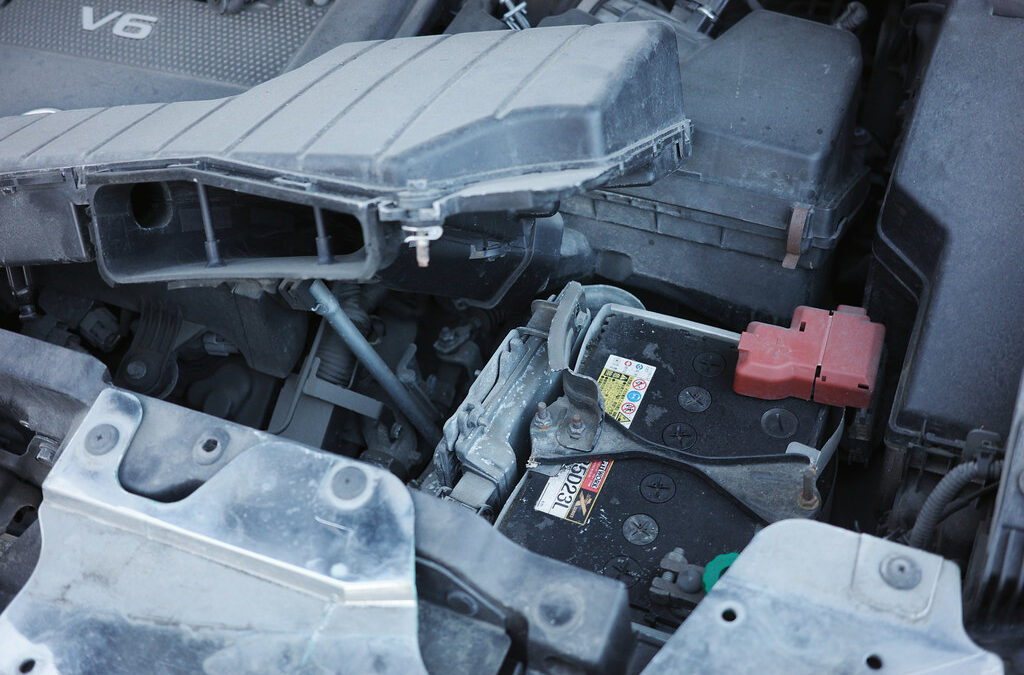
This is the one that gets people, my kid included. A clamp can look snug and still have a film of oxide between it and the post. Starting a car pulls a lot of current, and a thin layer of corrosion is enough to stop it.
- Wear safety glasses and gloves. Battery acid and corrosion will eat clothes and skin.
- Try to twist each clamp by hand. If either one moves, you may have found your problem.
- Remove the negative clamp first, then the positive. This keeps a wrench from shorting the positive to the body.
- Scrub the posts and the inside of the clamps with a terminal brush until they’re bright lead.
- White or blue-green crust can be neutralized with a baking soda and water mix. Keep it out of the battery vents.
- Reinstall positive first, then negative. Tighten until the clamp can’t be turned by hand. Don’t crush the post.
Also look along the cables. Corrosion can creep under the insulation and swell the cable near the clamp. A cable that’s stiff, swollen or green under the jacket can have high resistance even with clean ends.
The voltage drop test
If you want proof instead of a guess, do a voltage drop test. Put one meter lead on the battery post and the other on the clamp. Have a helper crank the engine. On a good connection the reading should be very small, well under a few tenths of a volt. A bigger number means resistance at that joint.
Step 4: Check the Engine Ground
The starter gets its return path through the engine block. A braided strap or cable connects the engine to the body or the battery negative. If that strap is corroded, broken or loose, you get clicking with a perfectly good battery.
- Follow the negative battery cable. One end usually goes to the body, and another goes to the engine or transmission.
- Look for a separate braided strap between the engine and the firewall or frame. Many vehicles have one or more.
- Check for frayed strands, green corrosion or a bolt that has backed out.
- Engine mounts that have been replaced sometimes leave a strap unbolted. Check after any mount job.
The quick test is the same voltage drop idea. Put one lead on the battery negative post and the other on a clean spot on the engine block. Crank it. A high reading points at the ground path.
A heavy jumper cable from the battery negative to a bare bolt on the engine is a common shortcut. If the car suddenly cranks with that jumper in place, you’ve found it. Clean the original connection or replace the strap. Don’t leave a jumper cable clamped in the engine bay as a permanent fix.
Step 5: Check Fuses, Relays and Switches
If there’s no click at all, or only a faint click from the dash area, look at the control side. The starter only engages when the car thinks it’s safe to start.
- Automatic transmission: try starting in Neutral instead of Park. A worn range switch can fail to report Park.
- Manual transmission: make sure the clutch pedal goes all the way to the floor. A floor mat can block it.
- Starter relay: many vehicles have one in the under-hood fuse box. Swap it with an identical relay that runs something else, like the horn, and try again.
- Fuses: check any fuse labeled for starter, ignition or engine control. The lid or owner’s manual shows which is which.
- Security light: a flashing key or lock symbol can mean the immobilizer doesn’t recognize the key. Try the spare key.
Check the owner’s manual for your vehicle’s layout. Relay part numbers and positions vary a lot, even within one brand.
Step 6: Test the Starter
If the battery is strong, the connections are clean, the ground is good, and you still get one heavy click, the starter is the prime suspect. Starters wear out. Brushes wear, solenoid contacts burn, and the motor can develop dead spots.
Simple checks at home
- With the car safely supported, check that both starter wires are tight. The big cable carries battery power. The small wire is the signal from the key.
- With a meter, confirm the big terminal has battery voltage at all times.
- Have a helper turn the key and check the small terminal. It should show battery voltage while the key is held in start.
- If both have voltage and the starter only clicks, the starter is likely bad.
The old trick of tapping the starter body with a hammer handle sometimes gets a worn starter to spin once more. If that works, it confirms the diagnosis. It’s not a repair. Plan on replacing the starter soon.
Getting under a car means proper support. Use jack stands on solid ground, chock the wheels, and never rely on a jack alone. Keep hands, hair and sleeves clear of belts and the fan. Disconnect the battery negative before you unbolt the starter.
Tow or go?
| What you notice | Likely cause | Verdict |
|---|---|---|
| Rapid clicking, starts fine after a jump | Weak battery or loose terminal | Go: fix terminals, test battery soon |
| Single click, starts after a few tries | Worn starter or solenoid contacts | Soon: replace before it strands you |
| Clicks, burning smell or smoke from a cable | Shorted or overheated cable | Stop: disconnect battery, tow it |
| Battery swollen, leaking or hissing | Failed battery | Stop: don’t jump it, replace it |
When to hand it to a shop
- The starter is buried under the intake manifold or needs other parts removed to reach it.
- You smell burning insulation or see melted wiring anywhere in the starting circuit.
- The security or immobilizer light stays on and the spare key doesn’t help.
- The vehicle is a hybrid or EV with a no-start problem.
- You’ve confirmed good voltage everywhere and still can’t find where the current stops.
FAQ
Can a bad alternator cause clicking?
Not directly. The alternator doesn’t run the starter. But a failing alternator won’t recharge the battery, so the battery runs down and then you get clicking. If the battery keeps going flat after a full charge, have the charging system tested.
Why does it click when warm but start when cold?
Heat raises resistance in a worn starter and in marginal cables. A starter that’s near the end of its life often shows up as a hot-restart problem first. Test the connections, then plan on a starter.
Will jump-starting fix a clicking problem?
If the battery was just low, a jump gets you going. It won’t fix a loose clamp, bad ground or worn starter. If a jump doesn’t help, stop jumping and start testing.
Is it safe to keep cranking?
No. Repeated cranking can overheat the starter and cables. Give it a break between tries and find the cause instead.
Pit-Stop Summary
The 30-Second Version
- Turn on the headlights and listen. Rapid clicks with dim lights point to the battery side.
- Measure battery voltage at rest and while cranking. Get a free load test.
- Remove, clean and tighten both terminals. Check the cables for hidden corrosion.
- Check the engine ground strap and do a voltage drop test.
- If voltage reaches the starter and it only clicks, replace the starter.